
News
IWO at the World Urban Forum 13 in Baku
On May 17-22, 2026, IWO took part in the World Urban Forum (WUF) 13, which was hold in Baku, Azerbaijan.
WUF is one of the most important global conferences on sustainable urban development, convened by UN‑Habitat. This year’s theme, “Housing the World: Safe and Resilient Cities and Communities,” directly addressed the global housing crisis and resulted in the Baku Call to Action.
Knut Hoeller, Executive Board Member of IWO e.V., contributed to two events of the Forum.
The first event Housing for Recovery and Resilience – Municipal Social Housing as Sustainable Development Goals in Action was organized by GIZ.
The panel focused on the preparation to the implementation of the municipal housing in Ukraine, strongly backed by Germany. The mayor of Hannover made a statement on the vital importance of local housing provision for a city, and that Hanover will continue to support its twin town in this area. EIB representative Grzegorz Gajda explained the EIB pilot program for financing the municipal housing projects and outlined the pathway for systemic financing of this sector in Ukraine. The representatives of IWO’s partner cities within the framework of SUR* project – Volodymyr Nikolaichuk, the Head of the Department of Housing and Communal Services of Mykolaiv City Council, and Svitlana Olshanska, Deputy Mayor of Zhytomyr city – presented the key results from the joint development of the municipal housing strategies, outlining cities’ housing recovery priorities.
“The main challenge in establishing social housing in Ukraine and other transition countries is overcoming the cultural and political stigma surrounding non-ownership housing models. This stigma is rooted in a distrust of state institutions that dates back to the socialist era. Once societies accept that renting doesn’t undermine freedom and is essential for internally displaced people, workers and students, a more resilient and diverse housing market can be achieved,” emphasized Knut Hoeller.
The second event From Ruins to Rental Affordable Housing as a Rapid, and Climate-Smart Response to Urban Displacement was organized by NGO Metalab and Habitat for Humanity Ukraine.
At this panel, the partners presented the results of building retrofitting project in Kalush, which created 48 social rental units and an operational and management model to further manage these apartments. Member of Parliament Pavlo Frolov, who is a co-author of the Law of Ukraine #4080, aimed at streamlining the retrofitting method for creation of the housing for IDPs, validated the concept of the project and called it a perfect example of how this direction of work can be implemented in Ukraine.
As IWO has been supporting this retrofitting project with the German experience of public housing management, Knut Hoeller contributed to the panel with highlighting the successes of the project the potential of scaling-up.
Yuliia Popova, Project manager of IWO e.V., spoke at two more events.
The event Risk Assessment in War-Affected Cities Guiding Housing-Centered Recovery and Urban Reconstruction was organized by Lviv City Institute and GIZ.
Yuliia Popova presented the municipal housing strategy as a framework for boosting long-term housing resilience and guiding long-term housing recovery in war-affected cities. The representatives of the SUR partner cities – the Mayor of Kremenchuk Vitaliy Maletskyi, and the Head of Housing Department Maryna Kharchenko, shared cities’ best practice on risk preparedness and response capacity in housing, as well as shared long-term plans for housing recovery, emphasizing the evidence for the need in municipal housing supply.
“When we talk about intrinsic resilience of the housing sector in our strategies, important characteristics to be achieved are the balance between the supply and demand, strong housing management stakeholders with sufficient technical overview of the housing stock, clear definition of responsibilities between the providers and all types of tenant. This would positively influence risks response capacity,” added Yuliia Popova.
The second event Policies, papers, and bricks Capacity Building for Crisis Preparedness and Response was organized by Kyiv School of Economy (KSE).
This interactive event located the recovering cities in the broader international and geopolitical context in the times of polycrises. For this, the cities need the multi-level governance perspective and digital tools to prepare for the crises and to managing of their consequences. As Yuliia Popova shared,
“When we talk about war-induced risks, we should consider that they are compounding pre-existing systemic weaknesses and vulnerabilities. Ukraine is almost solely housing ownership country, with a significant share of shadow rental market, with rather weak housing management and maintenance system, with the relationship at the housing market not being sufficiently regulated. With such preconditions, a mere seemingly technical reconstruction of a destroyed multi-apartment building or accommodation of the IDPs become legally and organizationally complicated. The cascade effects of blackouts intensify when the management system is poor. It is a classic case of risks overlapping with weaknesses of the system. However, as the definition of resilience suggests, a resilient system is the one that can evolve under external stressors, and this is what we are observing in Ukraine – most of the mentioned systemic weaknesses are being addressed by the ongoing housing reform. IWO supports this reform by building capacities locally.”
The panel presentations continued with practical workshops with all the participants where they could draft crisis response capacity building programs for different crisis scenarios.
Thus, the events covered broad spectrum of topics related to housing recovery: survival of the housing systems under attacks, housing retrofitting as a viable method to create social housing for the internally displaced population, long-term municipal housing strategies and the role of municipal housing in Ukraine’s recovery, as well as anchoring lessons learnt in policies and institutions.
Currently, IWO e.V. implements four projects in Ukraine related to housing recovery. The platform of WUF13 was a valuable opportunity to share the groundwork and findings of these projects, gained together with the partners. Under the SUR project, IWO cooperates with the cities of Poltava, Zhytomyr, Kremenchuk, Bila Tserkva, Mykolaiv and Kalush. Within FELICITY II, IWO supports the cities of Kryvyi Rih and Mykolaiv. Most of the cities were able to take part in WUF13 and to proudly share Ukraine’s progress towards improvement of the housing system amidst the constant attacks, which once again proves Ukraine’s resilience.
————————
The project “Strengthening of Urban Resilience in the Areas of Supply Infrastructure and Housing in Ukraine (SUR)” is as part of the German transitional development assistance, commissioned by the German Federal Ministry for Economic Cooperation and Development (BMZ) and implemented by GIZ Ukraine.

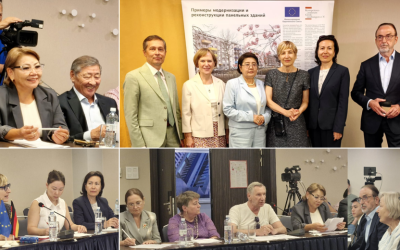
IWO and partners at the WUF 13 in Baku. Photos: IWO e.V.


For further information, please contact

Yuliia Popova

Almaty Conference: Professional Management & Refurbishment in Multi-Family Buildings
On 11 September, the “Housing Relations in Kazakhstan: Legislative Updates, Professional Management and Energy Efficiency in Multi-Family Houses” conference was held in Almaty. The conference brought together representatives of government bodies, homeowners'...
Round Table of the Coalition in Astana
First Round Table of the civil society coalition "Government and Citizens - Together for Energy-Efficient Housing" The first thematic roundtable of the civil society Coalition “Government and Citizens – Together for Energy-Efficient Housing” was held in Astana....

Project events of ENABLE in Kazakhstan
From the challenges of individual buildings to joint solutions - The Coalition holds its first thematic round table. On 8 September 2026 in Astana2:00 – 5:30 p.m., Park Inn by Radisson Astana, 8a Saryarka Street(hybrid format in person and online) the first thematic...