
News
Berlin’s experience in renovating the housing stock for the city of Aktobe

Cooperation with the Maslikhats
The study visit by a delegation from Aktobe to Berlin represented a practical continuation of the systematic cooperation between the Fund for the Development of Parliamentarism in Kazakhstan (Astana, Kazakhstan), a partner of the EU project ENABLE, and Kazakhstan’s local representative bodies – the Maslikhats (elected municipal or regional parliaments).
Cooperation with the Maslikhats is a key component of the activities of the EU project “ENABLE – Empowered Civil Society for a Sustainable and Efficient City”. This is because issues relating to housing and municipal services, energy efficiency, the modernisation of apartment blocks and citizen participation are directly linked to decisions taken at local level.
At the end of 2025, the Chair of the Maslikhat of the city of Aktobe, Anar Darzhanova, approached the “Eastern Europe Housing Initiative” (IWO) with a proposal to organise a working visit by a Kazakh delegation to Germany. The aim was to gather experience in the areas of energy efficiency in buildings, the modernisation of the housing stock, and the improvement of service quality in the housing and municipal sectors.
What the delegation learnt in Berlin
From 11 to 15 May 2026, a delegation from the city of Aktobe visited Berlin. The delegation included representatives of the Maslikhat and the Akimat (city administration) of Aktobe, as well as experts from the construction sector.
The visit and training programme, developed by the Housing Initiative for Eastern Europe (IWO e.V.), focused on the energy-efficient modernisation of the existing stock of multi-family houses. The programme centred on professional exchange and the sharing of practical experience and proven approaches from Germany.
Experts from the German Energy Agency (dena) provided a comprehensive insight into the German approach to decarbonising the housing stock. Topics covered in the presentations included the energy transition, funding programmes, practical examples of building renovation, quality assurance for renovation measures, and the role of energy consultants in the renovation process. The Kazakh participants showed particular interest in dena’s international experience, especially its projects in China.
Representatives from Gewobag, municipal housing association, guided the delegation through the Berlin housing estate ‘Buckower Höfe’. During the thematic excursion, concrete solutions for the energy-efficient modernisation of 1970s apartment blocks were presented. In addition, the participants gained insights into measures for adding storeys to existing buildings, constructing new housing, renewing technical infrastructure, and designing outdoor facilities.
The next day of the programme was dedicated to the Berlin district of Marzahn-Hellersdorf – Germany’s largest contiguous prefabricated housing estate. There, participants gained insights into strategic approaches and practical experiences regarding the development and modernisation of large housing estates. Representatives from the Kompetenzzentrum Großsiedlungen e.V. (Competence Centre for Large Housing Estates) presented measures and instruments of urban energy modernisation policy that have been developed and implemented over the past 30 years.
The IWO also presented the experiences of the Baltic states in modernising housing stock in industrialised urban areas. Particular attention was paid to the pilot projects supported by the IWO, as well as the establishment of support structures for homeowners based on the so-called ‘one-stop-shop’ principle. This approach guides owners through the entire modernisation process – from the initial consultation and energy audit, through project preparation and the identification of financing options, to collaboration with contractors and quality assurance of the measures carried out. The aim is to facilitate the planning and implementation of energy-efficient renovations and to provide owners with expert support at every stage of the process.
Another key component of the programme was an examination of the system of vocational education and training in the construction industry. Representatives from the Federal Institute for Vocational Education and Training (BIBB) and the Oberstufenzentrum Bautechnik I in Berlin provided information on the organisation of vocational training in Germany and the qualification of skilled workers required for high-quality and energy-efficient modernisation of the building stock.
To conclude the working visit to Berlin, the Kazakh experts were introduced to the concept of serial refurbishment of multi-family dwellings (Energiesprong). The introduction to this innovative concept by the IWO was complemented by an excursion to Ludwigsfelde to visit the pilot building. A five-storey residential block (prefabricated construction) was serially renovated by the housing association ‘Märkische Heimat’ in collaboration with the full-service provider Seeria Renova. The participants gained insights into the practical implementation of serial renovation solutions, which enable a significant acceleration of energy-efficiency modernisation while maintaining high-quality workmanship.
From learning to action
Anara Darzhanova, Chair of the Aktobe City Council, explained: “This trip has not only given us an insight into the technical aspects of energy-efficient building refurbishment, but has also provided a deeper understanding of how the refurbishment process itself is organised. The participants engaged in intensive discussions about the obstacles in our country that stand in the way of large-scale modernisation of apartment blocks – legislative, financial, social and others – as well as ways to overcome them. Upon our return to Kazakhstan, we intend to continue the discussion on the modernisation of Aktobe’s housing stock and to explore opportunities for implementing pilot projects for the energy-efficient modernisation of apartment blocks, in order to put the lessons learnt in Berlin into practice in our city.”
Abai Saktaganov, a member of the city council, supported the position of the Chair of the Aktobe City Council: “For us, this trip was an important practical experience! We have seen that the energy-efficient modernisation of housing is not just a question of technology or building renovation, but also a question of proper process organisation, cooperation with residents, transparency in decision-making and the responsibility of local authorities. I support Anara Darzhanova’s position: the experience gained must be used to discuss specific pilot projects in the city of Aktobe.”
Estay Sisenbaev, a member of the regional parliament, emphasised the importance of the experience gained for the entire Aktobe region: “The experience from Berlin has shown how important it is to view the modernisation of the housing stock as a collaboration between local representatives, executive bodies, experts, homeowners and civil society. We thank the organisers for the opportunity to learn about such approaches in practice. I agree that the next step should be to discuss the possibilities for applying this experience in the Aktobe region, including through pilot projects for the energy-efficient modernisation of apartment blocks.”
Thus, the study trip to Berlin was not only an opportunity to learn about German experiences, but also a first step towards drawing up a concrete action plan for the city of Aktobe.
The second step could be to discuss pilot projects for the energy-efficient modernisation of apartment blocks, involving the Maslikhat of the city of Aktobe, the Akimat, representatives of homeowners, the construction sector, experts and civil society organisations.
Such a dialogue could help to adapt the experiences gained in Berlin to local conditions and set in motion concrete measures for the sustainable modernisation of the housing stock in Aktobe.
Continuation of the dialogue in Berlin
The study tour was followed by further specialist events from 17 to 21 May, organised by the German Energy Agency (dena) and the German Society for International Cooperation (GIZ) as part of the ‘Energy Dialogue between the Republic of Kazakhstan and the Federal Republic of Germany’. The events were aimed at representatives of the Ministry of Industry and Construction of the Republic of Kazakhstan, as well as experts from the construction industry and the housing and utilities sector.
Representatives of the study tour organised by the IWO also took part in the dena and GIZ programme items: the Chair of the Maslikhat of the city of Aktobe, Anar Darzhanova, and the President of the Fund for the Development of Parliamentarism in Kazakhstan, Zauresh Batalova.
The aim of their participation was to continue the professional exchange on the energy-efficient modernisation of the housing stock and to discuss the legal, financial and institutional framework conditions for implementing comprehensive modernisation programmes in Kazakhstan’s cities. The focus was on issues of policy governance, financing, institutional cooperation and the development of suitable support instruments for owners of residential buildings.
Practical significance for ENABLE
The study visit to Berlin was one of the tools used to strengthen the capacities of the Kazakh participants in the ENABLE project. It made it possible to combine international experience, the local needs of the city of Aktobe and the overarching goal – strengthening the role of civil society and local authorities in decision-making on issues relating to sustainable housing management.
More broadly, the experience of cooperation between the Fund for the Development of Parliamentarism in Kazakhstan and the Maslikhats demonstrates that the sustainability of the ENABLE project depends not only on specialist materials and international exchange, but also on the ability to embed new approaches in real institutional practice at the local level.
Cooperation with the Maslikhats, including the Maslikhat of the city of Aktobe, is therefore one of the key factors for the long-term impact of the ENABLE project. It enables international experience and technical recommendations to be put into practice within local representative government, facilitates the discussion of pilot projects, and drives forward the energy-efficient modernisation of the housing stock in Kazakhstan.
Other pictures


The Kazakh delegation during the study tour, including a visit to a multi-family home in Ludwigsfelde that has undergone serial renovation (the last two photos). All photos: IWO e.V.
More information
Your contacts

Larissa Schreckenbach
Almaty Conference: Professional Management & Refurbishment in Multi-Family Buildings
On 11 September, the “Housing Relations in Kazakhstan: Legislative Updates, Professional Management and Energy Efficiency in Multi-Family Houses” conference was held in Almaty. The conference brought together representatives of government bodies, homeowners'...
Round Table of the Coalition in Astana
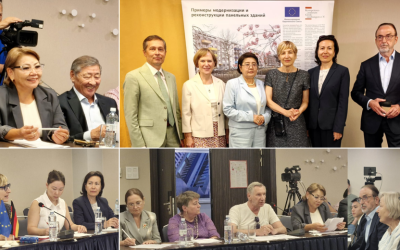
First Round Table of the civil society coalition "Government and Citizens - Together for Energy-Efficient Housing" The first thematic roundtable of the civil society Coalition “Government and Citizens – Together for Energy-Efficient Housing” was held in Astana....
Project events of ENABLE in Kazakhstan
From the challenges of individual buildings to joint solutions - The Coalition holds its first thematic round table. On 8 September 2026 in Astana2:00 – 5:30 p.m., Park Inn by Radisson Astana, 8a Saryarka Street(hybrid format in person and online) the first thematic...