
News
Workshop on strengthening resilience in the municipal housing sector in Ukraine
Together with partner organisations, the Housing Initiative for Eastern Europe (IWO e.V.) held a two-day workshop in Zhytomyr in April, bringing together representatives from six Ukrainian pilot cities: Zhytomyr, Poltava, Kremenchuk, Bila Tserkva, Mykolaiv and Kalush. The event focused on strengthening resilience in the municipal housing sector.
The event brought together international organisations, academic institutions, experts and non-governmental organisations. It also marked the first joint meeting of the working groups from the partner cities. During the workshop, analytical findings and recommendations for action were presented for Zhytomyr, Poltava and Kremenchuk, and an intensive exchange between the pilot cities was facilitated.
The workshop took place at a crucial stage, as Ukraine is driving forward its national housing reform and aligning its legal framework with European standards, including the commitments under the Ukraine Facility and the EU integration agenda. In this context, the pilot cities are actively developing strategies for the municipal housing sector that focus on resilience, rethink local governance structures and create viable models for affordable municipal housing. IWO regards the support provided to the cities in this complex transformation process as an important milestone.
After almost a year of collaboration within the SUR project, IWO presented comprehensive analyses and strategic recommendations. These include:
- the condition of the existing housing stock and investment needs (‘renovation debt’),
- an analysis of housing supply in relation to the income of the population and internally displaced persons (IDPs),
- structures and practices of housing administration as well as institutional capacities,
- results of a representative survey of internally displaced persons in all participating cities in cooperation with the Operatyvna Sociologiya Institute.
The analysis shows that internally displaced persons are predominantly reliant on the private rental market. At the same time, demographic structures vary considerably from city to city, for example, there is an increased need for accessible housing and age-appropriate provision in Poltava, which requires tailored housing policy solutions. In this context, it is clear that the framework conditions in the private rental market must be improved, including through stronger municipal measures and regulatory approaches.
The various levels of analysis provide a comprehensive picture of local housing markets and lay the groundwork for the systematic restoration and further development of the sector. The findings also contribute to better coordination between national and international actors in the reconstruction process. In developing the methodology, IWO drew on, among other things, German housing market monitoring.
Pilot projects play a central role in this: municipal and NGO-initiated housing projects, as well as comprehensive renovation measures, serve as practical learning platforms. Cities with relevant experience have been shown to possess greater expertise and implementation capacity in municipal housing construction. At the same time, these pilot projects pave the way for larger investments and structural changes.
This momentum is also evident at the political level: in April 2026, the German and Ukrainian governments adopted a Strategic Partnership Declaration as part of their first intergovernmental consultations since 2004. This includes, among other things, the joint promotion of affordable and social housing, the integration of vulnerable groups, and the establishment of municipal housing companies, including financial support from Germany. In addition, joint investment projects are to be initiated, which will also open up investment opportunities for German companies.
The workshop was organised as part of the project “Strengthening of Urban Resilience in the Areas of Supply Infrastructure and Housing” (SUR). This is part of Germany’s Strukturbildende Übergangshilfe, commissioned by the Federal Ministry for Economic Cooperation and Development (BMZ) and implemented by the German Society for International Cooperation (GIZ Ukraine) GmbH.
IWO would like to express its sincere thanks to all participating partners, experts and the cities involved for their cooperation, trust and commitment. Their efforts form the basis for sustainable development in the Ukrainian housing sector.


During the workshop. Copyright: GIZ.
For further information, please contact

Knut Höller

Yuliia Popova
Almaty Conference: Professional Management & Refurbishment in Multi-Family Buildings
On 11 September, the “Housing Relations in Kazakhstan: Legislative Updates, Professional Management and Energy Efficiency in Multi-Family Houses” conference was held in Almaty. The conference brought together representatives of government bodies, homeowners'...
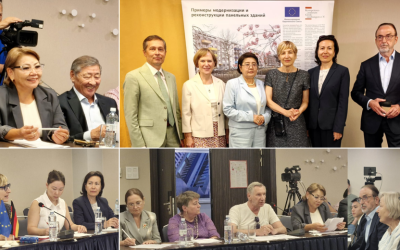
Round Table of the Coalition in Astana
First Round Table of the civil society coalition "Government and Citizens - Together for Energy-Efficient Housing" The first thematic roundtable of the civil society Coalition “Government and Citizens – Together for Energy-Efficient Housing” was held in Astana....

Project events of ENABLE in Kazakhstan
From the challenges of individual buildings to joint solutions - The Coalition holds its first thematic round table. On 8 September 2026 in Astana2:00 – 5:30 p.m., Park Inn by Radisson Astana, 8a Saryarka Street(hybrid format in person and online) the first thematic...